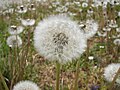
قاصدک
| فارسی | English | ||||||||||||||||||||||||||||||||||||||||||||||||||||||||||||||
برای دیگر کاربردها، قاصدک (ابهامزدایی) را ببینید.
گُل قاصِدَک که بنامهای هند بابری، خبرآرو و کاسنی بری نیز معروف است گیاهی است علفی و دائمی که ساقه آن به ارتفاع ۴۰ سانتی متر میرسد. این گیاه دارای ریشهای است به رنگ قهوهای مایل به زرد که پر از شیرابه سفید رنگی میباشد.
نام علمی [ویرایش](Taraxacum) نام علمی گیاهی است که کاسنی زرد نام دارد نام علمی گل قاصدک (Cirsium vulgare) میباشد. مکان رشد [ویرایش]در انتهای ساقه گل آن قرار دارد. برگهای گل قاصدک سبز رنگ و بریدگیهای مثلث شکل و نوک تیز دارد و بر روی سطح زمین میباشد. گل قاصدک در وسط چمن، حاشیه شوره زار، کنار جادهها و اراضی بایر و بطور کلی در همه جا میروید. گل قاصدک در حدود ۱۵ نوع گوناگون دارد. موراد استفاده [ویرایش]زنبور عسل این گیاه را بسیار دوست دارد و شهد زیادی از آن بدست میآورد. برگهای جوان گل قاصدک را معمولاً با سالاد میخورند و چون خیلی تلخ است باید آن را با ترشی یا آبلیمو مصرف کرد. از قسمتهای گوناگون گیاه مانند ریشه، برگ و شیرابه آن در درمان استفاده میشود. ترکیبات شیمیایی [ویرایش]ریشه این گیاه دارای مادهای تلخ به نام تراگزاسین، کولین و تاراگزاسترول میباشد همچنین در ریشه آن مقدار کمی تانن وجود دارد و نوعی الکالوئید به نام تاکزین و تاراگزه رول در اعضای این گیاه یافت میشود. املاح کلسیم، پتاسیم، آهن، منیزیوم، سدیم، منگنز، فسفر، سیلیس و گوگرد در این گیاه ثابت شدهاست. خواص داروئی [ویرایش]این گیاه از نظر پزشکی قدیم ایران سرد و خشک است و از دیرباز برای درمان بیماریهای کبدی بکار میرفتهاست.
محل رویش [ویرایش]پراکندگی این گیاه در کره زمین طوری است که در غالب نواحی اروپای شمالی، غرب آسیا، شمال آفریقا و آمریکای شمالی میروید. تا کنون بالغ بر ده گونه از این نوع گیاه شناخته شدهاست. منابع [ویرایش]
|
"Dandelion" redirects here. It often refers specifically to Taraxacum officinale. For similar plants, see False dandelion. For other uses, see Dandelion (disambiguation)
Taraxacum (pron.: /təˈræksəkʉm/) is a large genus of flowering plants in the family Asteraceae. They are native to Eurasia and North and South America, and two species, T. officinale and T. erythrospermum, are found as weeds worldwide.[1] Both species are edible in their entirety.[2] The common name dandelion (/ˈdændɨlaɪ.ən/ DAN-di-ly-ən, from French dent-de-lion, meaning "lion's tooth") is given to members of the genus, and like other members of the Asteraceae family, they have very small flowers collected together into a composite flower head. Each single flower in a head is called a floret. Many Taraxacum species produce seeds asexually by apomixis, where the seeds are produced without pollination, resulting in offspring that are genetically identical to the parent plant.[3]
Description [edit]The species of Taraxacum are tap-rooted biennial or perennial herbaceous plants, native to temperate areas of the Old and New worlds.[clarification needed] The leaves are 5–25 cm long or longer, simple and basal, entire or lobed, forming a rosette above the central taproot. The flower heads are yellow to orange coloured, and are open in the daytime but closed at night. The heads are borne singly on a hollow stem (scape) that rises 1–10 cm or more[4] above the leaves and exudes a milky latex when broken. A rosette may produce several flowering stems at a time. The flower heads are 2–5 cm in diameter and consist entirely of ray florets. The flower heads mature into spherical seed heads called "blowballs"[5] or "clocks" (in both British and American English)[6][7][8][9] containing many single-seeded fruits called achenes. Each achene is attached to a pappus of fine hairs, which enable wind-aided dispersal over long distances. The flower head is surrounded by bracts (sometimes mistakenly called sepals) in two series. The inner bracts are erect until the seeds mature, then flex downward to allow the seeds to disperse; the outer bracts are always reflexed downward. Some species drop the "parachute" from the achenes; the hair-like parachutes are called pappus, and they are modified sepals. Between the pappus and the achene, there is a stalk called a beak, which elongates as the fruit matures. The beak breaks off from the achene quite easily, separating the seed from the parachute. Seed dispersal [edit]A number of species of Taraxacum are seed dispersed ruderals that rapidly colonize disturbed soil, especially the common dandelion (T. officinale), which has been introduced over much of the temperate world. After flowering is finished, the dandelion flower head dries out for a day or two. The dried petals and stamens drop off, the bracts reflex (curve backwards), and the parachute ball opens into a full sphere. Finally, the seed-bearing parachutes expand and lift out of it. The parachute drops off the achene when it strikes an obstacle.[citation needed] After the seed is released, the parachutes lose their feathered structure and take on a fuzzy, cotton-like appearance, often called "dandelion snow".[citation needed] False dandelions [edit]Many similar plants in the Asteraceae family with yellow flowers are sometimes known as "false dandelions". Dandelions are very similar to catsears (Hypochaeris). Both plants carry similar flowers, which form into windborne seeds. However, dandelion flowers are borne singly on unbranched, hairless and leafless, hollow stems, while catsear flowering stems are branched, solid and carry bracts. Both plants have a basal rosette of leaves and a central taproot. However, the leaves of dandelions are smooth or glabrous, whereas those of catsears are coarsely hairy. Other plants with superficially similar flowers include hawkweeds (Hieracium) and hawksbeards (Crepis). These are readily distinguished by branched flowering stems, which are usually hairy and bear leaves. Classification [edit]The genus is taxonomically complex, with some botanists dividing the group into about 34 macrospecies, and about 2000 microspecies;[10] approximately 235 apomictic and polyploid microspecies have been recorded in Great Britain and Ireland.[11] Some botanists take a much narrower view and only accept a total of about 60 species.[10] Selected species [edit]
Cultivars [edit]
History [edit]Dandelions are thought to have evolved about thirty million years ago in Eurasia.[15] They have been used by humans for food and as a herb for much of recorded history.[16] They were introduced to North America by early European immigrants. Names [edit]The Latin name Taraxacum originates in medieval Persian writings on pharmacy. The Persian scientist Al-Razi around 900 (A.D.) wrote "the tarashaquq is like chicory". The Persian scientist and philosopher Ibn Sīnā around 1000 (A.D.) wrote a book chapter on Taraxacum. Gerard of Cremona, in translating Arabic to Latin around 1170, spelled it tarasacon.[17] The English name, dandelion, is a corruption of the French dent de lion[18] meaning "lion's tooth", referring to the coarsely toothed leaves. The plant is also known as blowball, cankerwort, doon-head-clock, witch's gowan, milk witch, lion's-tooth, yellow-gowan, Irish daisy, monks-head, priest's-crown and puff-ball;[19] other common names include faceclock, pee-a-bed, wet-a-bed,[20] swine's snout, [21] white endive, and wild endive.[22] The name "dandelion" is a cognate of the names in many other European languages, such as the Welsh dant y llew, Italian dente di leone, Catalan dent de lleó, Spanish diente de león, Portuguese dente-de-leão, Norwegian Løvetann, Danish Løvetand and German Löwenzahn. The colloquial German word Pusteblume (blow-flower) refers to the children's game of blowing away the seeds of the ripe taraxacum flower. In modern French, the plant is named pissenlit (or vernacular pisse au lit).[citation needed] Likewise, "piss-a-bed" is an English folk-name for this plant,[23] as are piscialletto in Italian, pixallits in Catalan and meacamas in Spanish.[citation needed] These names refer to the strong diuretic effect of the plant's roots,[23] either roasted or raw. In various north-eastern Italian dialects, the plant is known as pisacan ("dog pisses"), because they are found at the side of pavements.[24] In France, it is also known as laitue de chien (dog's lettuce), salade de taupe (mole's salad), florin d'or (golden florin); cochet (cockerel); fausse chicorée (false chicory); couronne de moine (monk's crown); baraban.[citation needed] In several European languages, the plant, or at least its parachute ball stage, is named after the popular children's pastime of blowing the parachutes off the stalk: Pusteblume German for "blowing flower"), soffione (Italian for "blowing", in some northern Italian dialects),[24] dmuchawiec (Polish, derived from the verb "blow"), одуванчик (Russian, derived from the verb "blow").[citation needed] In other languages, the plant is named after the white latex found in its stem, e.g., mlecz (derived from the Polish word for "milk"), mælkebøtte (Danish for "milk pot"), kutyatej (Hungarian for "dog milk"), маслачак (Serbian, from маслац meaning "butter").[citation needed] The Lithuanian name kiaulpienė can be translated as "sow milk".[citation needed] Similarly, in Latvian it is called pienene, derived from piens ('milk'), as in Catalan is used lletsó (derived from the word llet that means "milk").[citation needed] The alternative Hungarian name gyermekláncfű ("child's chain grass") refers to the habit of children to pick dandelions, remove the flowers, and make links out of the stems by "plugging" the narrow top end of the stem into the wider bottom end.[citation needed] In Bulgarian and Macedonian, its name (respectively глухарче and глуварче) is derived from the word for 'deaf' (глух, глув), because of a traditional belief that dandelion parachutes can cause deafness. In Turkish, the dandelion is called karahindiba meaning "black endive or chicory".[25] While the root flesh is white, the outer skin of the root is dark brown or black. In Swedish, it is called maskros ('worm rose') after the small insects (thrips) usually present in the flowers.[26] In Finnish and Estonian, it is called voikukka and võilill, respectively, meaning "butter flower", referring to its buttery colour.[citation needed] Similarly, in Croatian, the name of this plant (maslačak) is derived from the noun maslac, meaning butter.[27] In Dutch, it is called paardenbloem, meaning "horse-flower". In Chinese, it is called pú gōng yīng (蒲公英), meaning "flower that grows in public spaces by the riverside".[citation needed] In Persian, it is called qasedak (قاصدک), meaning the "small postman", because of a belief that it brings good news. In Portuguese, it is called dente-de-leão, also meaning "lion's tooth". Portuguese children also call them "o teu pai é careca" (your dad is bald) due to a game which consisted on blowing on a dandelion. If it was left with no seeds, that would mean the other kid's dad was bald. In Greek, its seed (and most often the plant itself) is called a kleftis (κλέφτης) meaning "thief" because it is very difficult to catch once airborne. In Cyprus, the plant is called a pappous (παππούς) meaning "grandfather" due to the white-coloured seed head resembling the white hair of an older man. In Romanian it is generally called păpădie, but other rare regional names have been documented, like buhă, cicoare, crestățea, lăptucă, lilicea, mâță, papalungă, pilug, turci, curu-găinii, floarea-broaștei, floarea-găinii, floarea-mălaiului, floarea-sorului, floarea-turcului, floare galbenă, gălbinele-grase, gușa-găinii, ouăle-găinilor, papa-găinii, părăsita-găinilor or pui-de-gâscă. Properties [edit]As a beneficial weed [edit]The dandelion plant is a beneficial weed, with a wide range of uses, and is even a good companion plant for gardening. Its taproot will bring up nutrients for shallower-rooting plants, and add minerals and nitrogen to soil. It is also known to attract pollinating insects and release ethylene gas which helps fruit to ripen.[28] Taraxacum seeds are an important food source for certain birds.[29] As a noxious weed [edit]The species Taraxacum officinale is listed as a noxious weed in some jurisdictions,[30] and is considered to be a nuisance in residential and recreational lawns in North America.[31] It is also an important weed in agriculture and causes significant economic damage because of its infestation in many crops worldwide.[30] Culinary use [edit]Dandelions are found on all continents and have been gathered since prehistory, but the varieties cultivated for consumption are mainly native to Eurasia. A perennial plant, its leaves will grow back if the taproot is left intact. To make leaves more palatable, they are often blanched to remove bitterness.[16] Dandelion leaves and buds have been a part of traditional Sephardic, Chinese, and Korean cuisine. In Crete, Greece, the leaves of a variety called Mari (Μαρί), Mariaki (Μαριάκι) or Koproradiko (Κοπροράδικο) are eaten by locals, either raw or boiled, in salads. Taraxacum megalorhizon, a species endemic to Crete, is eaten in the same way; it is found only at high altitudes (1000 to 1600 m.) and in fallow sites, and is called pentaramia (πενταράμια) or agrioradiko (αγριοράδικο).[32] The flower petals, along with other ingredients, are used to make dandelion wine. The ground, roasted roots can be used as a caffeine-free dandelion coffee.[33] Dandelion was also traditionally used to make the traditional British soft drink dandelion and burdock, and is one of the ingredients of root beer. Also, Dandelions were once delicacies eaten by the Victorian gentry mostly in salads and sandwiches. Dandelion leaves contain abundant vitamins and minerals, especially vitamins A, C and K, and are good sources of calcium, potassium, iron and manganese.[34] Dangers [edit]Dandelion pollen may cause allergic reactions when eaten, or adverse skin reactions in sensitive individuals. Contact dermatitis after handling has also been reported, probably from the latex in the stems and leaves.[35] Due to its high potassium level, dandelion can also increase the risk of hyperkalemia when taken with potassium-sparing diuretics.[36] The consumption of dandelion leaves has also been implicated in occurrences of fasciolosis.[37] Medicinal uses [edit]Historically, dandelion was prized for a variety of medicinal properties, and it contains a wide number of pharmacologically active compounds.[38] Dandelion is used as a herbal remedy in Europe, North America and China.[38] It has been used in herbal medicine to treat infections, bile and liver problems,[38] and as a diuretic.[38]
An ant foraging on a dandelion
Insects [edit]Dandelions are important plants for northern hemisphere bees, providing an important source of nectar and pollen early in the season.[39] Dandelions are used as food plants by the larvae of some species of Lepidoptera (butterflies and moths). See List of Lepidoptera that feed on dandelions. They are also used as a source of nectar by the pearl-bordered fritillary (Boloria euphrosyne), one of the earliest emerging butterflies in the spring. Culture [edit]Four dandelion flowers are the emblem of White Sulphur Springs, West Virginia.[40] The citizens celebrate spring with an annual Dandelion Festival. The dandelion is the official flower of the University of Rochester and "Dandelion Yellow" is one of the school's official colors. The Dandelion Yellow is an official University of Rochester song.[41] See also [edit]
References [edit]
External links [edit]
| ||||||||||||||||||||||||||||||||||||||||||||||||||||||||||||||